

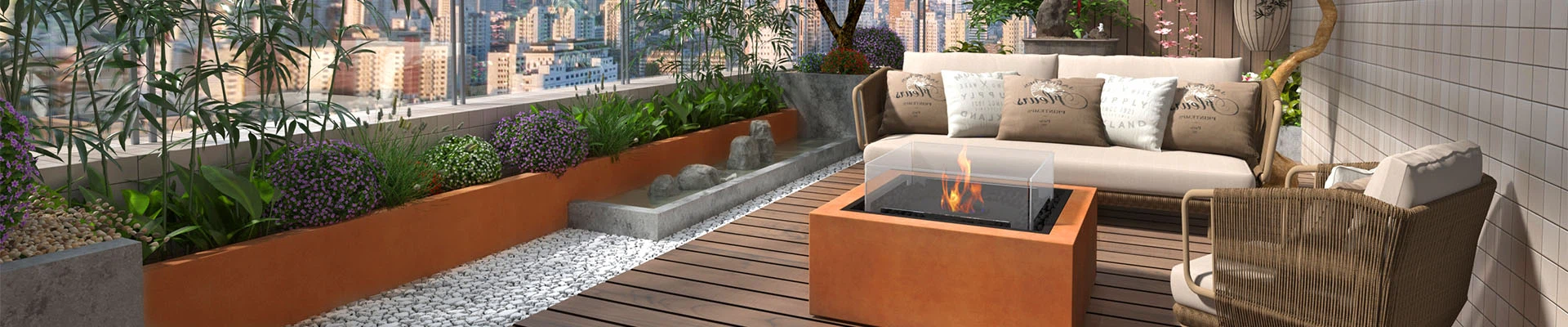



Corten steel has become a popular metal type thanks to its unique look and naturally oxidizing finish. This makes it an ideal choice for a variety of roofing architectural projects. Corten roofing buildings weather beautifully thanks to a group of steel alloys that form a protective rust-like appearance, eliminating the need for continual repainting.Corten steel roofing has been designed for wall cladding and screening applications and is manufactured from corten steel, an alloy that eliminates the need for painting by forming a stable rust-like patina. The layer protecting the weathered steel roofing surface develops and regenerates continuously when subjected to the influence of the weather.
Advantages of Corten Roof
Metal roofs are long lasting
Corten roof just last longer than other materials. Depending on the specific material, corten roof can last 40-70 years. Traditional asphalt roofing only lasts about 12 to 20 years. The extended lifespan of a corten roof is why many make the switch when re-roofing or with new construction.
Corten roof are energy efficient
While installing a corten roof can be expensive, the money spent on the installation can be made up from the savings in monthly cooling and heating costs. Corten roof reflect solar radiant heat instead of absorbing it, which often reduces cooling costs.
Corten roof are durable and require minimal maintenance
Corten roof is long-lasting because it is extremely durable. It can sustain strong wind gusts without corroding or cracking. Plus, corten roof do not require the costly, routine maintenance that other roofing materials require.
Corten roof are fire resistant
Corten roof are safer because they will not spark and ignite into flames when exposed to a wildfire or struck by lightning.




Why Choose Us
Our Factory
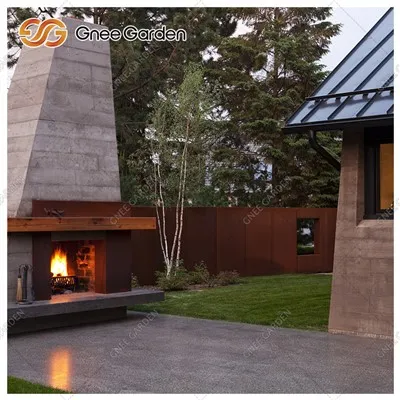
Providing total solutions to our customers, we therefore specialize in customizing a wide range of metal products while offering standard products. From curtain walls, fire pits, water features, garden planters, fence panels, and privacy screens to gazebos.
One-stop Service
Since the company was founded, gnee has always adhered to the principle of a one-stop service system.It runs through the whole transaction process from pre-sale consultation, order confirmation, product design, production, and transportation to after-sale maintenance.
Production Advantage
With its factory and strict control over quality and efficiency, gnee garden company can offer a private, customized service that ensures clients receive a tailored solution to meet their requirements.
Professional Team
Our office environment is nearly 200 employees, a young, professional team. Continuously seeking new and new changes to make our products easy to use, convenient, and safe, because your choice makes us more motivated.
Now that you have decided to purchase a rusted roof it is important that you realize how to make it last a long time. These three tips will help you make the correct choices for your roof.
Use a heavy gauge steel in a 20ga or 22ga. Using a heavy gauge steel is the single most important thing to increase the longevity of your rusted roof.
Prevent moisture and debris entrapment - Keeping the roof free of debris and falling objects will help the long-term outlook of your home.
Corten roofing should have a minimum slope of 3 in 12. If water can accumulate in pockets, those areas will experience higher corrosion rates, provision for drainage must be made to help increase the lifespan of your roof.
Do not use corten roofing in these climates:
Weathering steel is sensitive to climates with exposure to salt laden air.
Climates in which the material will be subject to excessive moisture.
The Main Reasons Corten Roofing May Not Be The Right Fit For Your Home
Rusted Roofing Is Not Pre-weathered
Corten steel does not arrive pre-rusted. When your roofing or siding shows up at the jobsite it will have a dull gray appearance and not a rusted appearance. You do not need to do anything other than expose it to the weather. There are different stages of weathering that the steel will go through. It will develop some patina immediately when it gets wet. It will continue to patina further as it is exposed to the weather. After about three months you will have a decent patina that continues to rust orange and eventually cinnamon brown.
There Is No Warranty For Corten Or Bare Steel
When you buy corten steel you are buying a product that is designed to rust. That type of product is not warrantable. However, it is still an excellent product that will yield a long lifespan with the correct weather conditions. There is a standard disclaimer that is inserted in every order confirmation.
Corten Or Bare Steel Disclaimer
Rust runoff will likely stain the surrounding surfaces. Western states decking, inc does not provide any warranties, express or implied on cold rolled bare (black steel) or a606 type 4. This product is intended to naturally weather and rust.
●Note: All warranties, express or implied, are disclaimed and excluded; Including without limitation any implied warranty of merchantability or fitness for a particular purpose or us material is not pre-rusted load calculations and load tables do not apply to any a606 or bare steel product. Please contact a professional engineer for your specific application of the product.
A606-4 should not be used with dissimilar metals other than stainless steel. This will decrease the lifespan of the product. Screws to be stainless steel.
Rust Stains
If you have a rusty roof or wall you will have rust run off. Rust stains are unavoidable. It would not be a good idea to have a rusted roof or wall next to white concrete.
It would also be a bad idea to have a corten wall in an area where people’s clothes would rub against it. This would lead to orange clothing. I would call these conditions bad architecture or design.
The only way to control the rust run off is installation of gutters and downspouts. These will allow you to divert the run off to a different location. The rust run off will be more prevalent when the steel is new and will decrease as the rust matures.
Incorrect Environmental Conditions For Corten Roofing
The idea behind rusted roofing is that the steel is allowed to rust and that rust forms a protective coating that slows the rate of future corrosion. Not all environmental conditions will allow this to happen correctly. Corten or bare steel is not recommended near salt spray environments, areas of high humidity, and frequent rain locations as it will shorten the life expectancy of the products.
These environments can create a condition in which the rust layer never reaches a stable point. Over time, the steel can become perforated and may need to be replaced.
There Are No Load Charts Or Engineering For Rusted Roofing Or Wall Panels
Corten or bare steel should be installed over a solid substrate. It is an architectural panel and not a structural panel. There is no engineering, load charts, or wind uplift information. Unless you are spanning from support to support than a load chart is not important. Any engineering that was accurate at time of delivery would be different after many years of the product rusting.
Incorrect Roofing Or Wall Design For Corten Or Bare Steel
Here are the main considerations when designing your project:
●Roof pitch
Your roof should have a pitch of a minimum 3” in 12”. We have sold jobs in which the pitch is less than 3/12, but our recommendation is 3/12.
●Eliminate standing water
Rusted roofing must go through wet and dry cycles.
Areas that have standing water will rust at a much faster rate. Eliminate moisture and debris entrapment. Corten and bare steel are not rust proof materials. If water accumulates in pockets, those areas will corrode quicker so provision for drainage must be made.
Appearance Of Corten Steel
Since the patina formation on corten is a natural process, the results are somewhat unpredictable. The color finish will not be exactly the same from one project to the next. Sometimes the finish may not even be totally consistent within a project. As a general rule, weathering steel in wetter climates will have a more reddish hue compared to the same steel in drier climates. Regardless of which climate the steel oxidizes in, the final outcome will have a darker, earthy tone.
The Right Weather Elements For Corten
A corten roof needs to be in an environment with alternating wet and dry cycles to properly form the adhered protective layer that it’s known for. During these rotating cycles, the rust layer becomes a little thicker, while the underlying solid steel becomes thinner as the metal goes between being damp and drying out.
The rust layer takes a couple of years to stabilize, resulting in the highly desired, maintenance-free material. However, if the rust layer is in the wrong climate that prevents it from stabilizing, the metal will become punctured and ultimately have to be replaced.
The Climates To Avoid With A Corten Roof
A corten roof should not be on the coastline
Coastal environments.Properties near the ocean, especially those within one mile from the ocean, are surrounded by a high amount of salt particles in the atmosphere. When salt spray is continuously deposited onto a corten surface, it prevents the development of the inner protective oxide layer from forming.
Any area that is very humid with heavy rainfall, such as a tropical environment, will not be good for corten. The consistent moisture will prevent the rust from reaching its stable point. Corten needs to be able to dry out completely after it gets wet. Otherwise, the protective oxides will not be able to crystallize, and the areas that are not able to dry out will experience higher corrosion rates.


Other Considerations
If you do live in a climate that supports the use of corten, there are still other things you have to consider when using this kind of material.
The rate of patina formation
The rate at which the steel stabilizes and forms its desired patina depends on the climate. While it’s generally quick in large urban centers, the weathering rate is much slower in more rural environments. Also, if the corten panels are going to be used in interior designs, the wet/dry cycles are absent and it will not age correctly. You will have to pre-rust the steel and then it can be installed inside once the patina has formed.
Appearance
Since the patina formation on corten is a natural process, the results are somewhat unpredictable. The color finish will not be exactly the same from one project to the next. Sometimes the finish may not even be totally consistent within a project. As a general rule, weathering steel in wetter climates will have a more reddish hue compared to the same steel in drier climates. Regardless of which climate the steel oxidizes in, the final outcome will have a darker, earthy tone.
Roof pitch
Corten should only be placed on roofs with the correct pitch. While the roof does not necessarily need a high pitch for corten, there should at least be enough slope to cause any rain or snow to runoff. The recommended minimum pitch for a corten roof is 3:12. A roof with at least this pitch will prevent rainwater from accumulating in pockets on a corten roof that would cause a higher corrosion rate.
The Top 7 Mistakes Made When Installing a Corten Roof
Incorrect Measurements
One of the easiest ways to delay, or add cost to your project is by not measuring the roof correctly. Having the wrong measurements will lead to ordering panels that are the wrong size. Always do a field measurement prior to ordering roof or siding panels.
Try to avoid ordering off plans or a job that is not built in order to speed up lead times. We often see panels that are either too long or short due to this. Use a roofing calculator to help with a more accurate measurement.
Installing Fasteners Incorrectly
Improperly installed fasteners are one of the most common reasons for corten roof leaks. Fasteners should be screwed in with little resistance. They should not be under tightened nor overtightened.
If the washer is off center and visible, then the fasteners have been overtightened. If the gaskets are not compressed firmly against the surface, then the fasteners are under tightened.
Oil Canning
Oil canning, sometimes referred to as “stress wrinkling”, is the visible waviness or rippling in the flat areas of corten roof as shown below. Oil canning is in all panels due to roll form process and is not a means for rejection. However, it can be more obvious in certain panels. The waviness of a corten roof can help disguise oil canning while it's more visible in panels with flat surfaces.
Underlayment
Using the wrong underlayment, or skipping underlayment altogether, is a common installation error that can be easily avoided. Underlayment should always be used as it provides an extra layer of protection against condensation, minimizing the likelihood of damage occurring.
It’s common for building codes to require the use of underlayment as well as specify which type of underlayment is allowed. Using the wrong underlayment can also result in a voided warranty.
Incorrect Sealant
Sealants are used to keep out elements that could compromise the roof, such as water or dirt. When not applied correctly, the roof could be prone to leaks.
It is also important to use sealant specifically made for metal roofing. Other types of caulking may not adhere to the paint on the panels. The sealant must also be flexible enough that it can expand with the metal without breaking its seal.
Improperly Attaching Flashing
Flashing keeps water from entering a structure at a roof penetration or joint. When it is not attached correctly, moisture is able to get in, resulting in a leak. Any area that has penetrates into the roof, such as ventilation ducts, chimneys, and skylights, should have flashing installed surrounding it.
Make sure the correct flashing is used, along with the correct size, so that the area is completely covered. Flashing seams should be properly sealed to allow water to flow on top of the material and prevent it from going underneath the roofing.
Metal Roof Installation Experience
All roofing system installations are not created equal, and it’s important that the professional doing the work is experienced specifically with metal roofing.
If you are a homeowner, you want to make sure you are hiring a qualified contractor whenever you are having any kind of work done on your home. For a metal roof, ask the right questions during your consultation to ensure you are hiring a qualified roofing contractor with previous metal roof experience.
How to Maintenance Corten Roof
The Importance Of Maintaining Your Corten Roof
Corten roof are prone to wear and tear, leaks, dents, degradation and galvanic corrosion. Perform regular maintenance at least once a year.
Surface Maintenance
Surface maintenance can be performed without a professional, but you must take extra precautions to ensure your safety. Surface maintenance tasks include removing dirt and other harmful elements from the surface of your roof. Begin by cleaning debris from gutters and guttering that can lead to water buildup and premature corrosion. This debris can also get stuck in seams and other "dead spots" on the roof, which can stain or scratch the paint, thus damaging the panel's outer protective coating.
Structural Maintenance
Structural maintenance for corten roof is more in-depth and should be performed by a qualified professional. Structural maintenance includes inspecting and/or securing fasteners, rivets and screws. These components attach the panels to the overall structure, so it's important to ensure that the panels don't loosen, bend, or become missing as they expand and contract over time. Panel joints should also be inspected by a professional at least once a year. Other structural maintenance includes inspecting and replacing sealants to prevent the natural elements from penetrating the metal roofing system.
FAQ
We're professional corten roof manufacturers and suppliers in China, specialized in providing high quality customized service. We warmly welcome you to buy bulk corten roof in stock here from our factory. For price consultation, contact us.
residential roof, uv resistant roof, Corten Steel Corrugated Roofing