

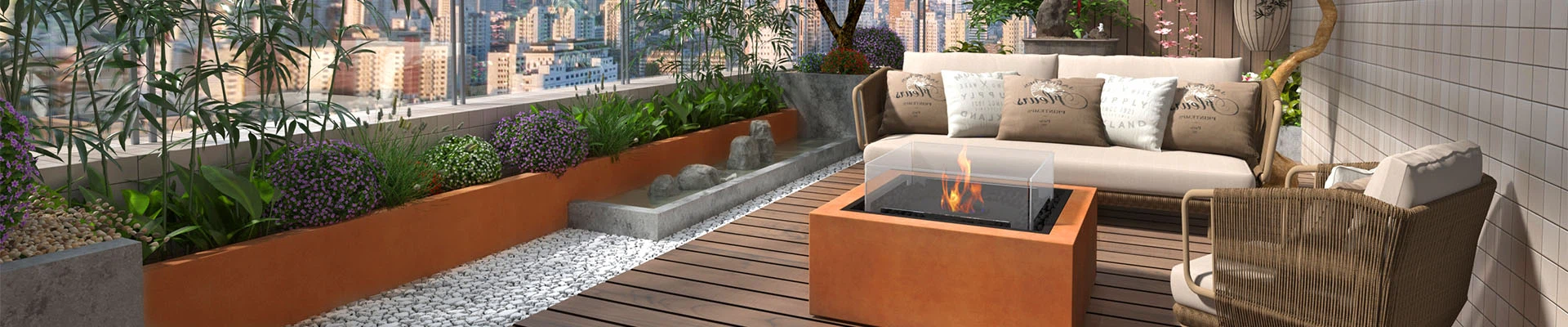


GNEE (TIANJIN) GROUP CO LTD. is a professional manufacturer of weatherproof steel gardening products. Providing total solutions to our customers, we therefore specialize in customizing a wide range of metal products while offering standard products. From curtain walls, fire pits, water features, garden planters, fence panels, and privacy screens to gazebos, we even have a range of outdoor barbecue products.
Founded in 2016 with a registered capital of 5 million RMB, we have more than 36,000 square meters of factory space and 800 square meters of office environment and have completed more than 80 landscape projects with more than 100 companies around the world. The self-designed Corten Stabilized Rust Technology solves the environmental pollution problem and has been recognized by dozens of projects.
Why choose us?
Production advantage
With its factory and strict control over quality and efficiency, Gnee Garden Company can offer a private, customized service that ensures clients receive a tailored solution to meet their requirements.
Professional team
Our office environment is nearly 200 employees, a young, professional team. Continuously seeking new and new changes to make our products easy to use, convenient, and safe, because your choice makes us more motivated.
One-stop service
Since the company was founded, Gnee has always adhered to the principle of a one-stop service system. It runs through the whole transaction process from pre-sale consultation, order confirmation, product design, production, and transportation to after-sale maintenance.
Rich experience
Founded in 2016 with a registered capital of 5 million RMB, we have more than 36,000 square meters of factory space and 800 square meters of office environment and have completed more than 80 landscape projects with more than 100 companies around the world.


What is Corten Bridge
When it comes to bridge building, weathering steel has gained popularity for its durability and aesthetic appeal. In fact, weathering steel has been used in more than 10,000 bridges since being introduced in 1964, and properly-designed weathering steel bridges have achieved lifespans of up to 120 years.
Is corrosion-resistant
Due to its chemical makeup, weathering steel forms a protective rust patina that prevents corrosion in suitable environments.In fact, the corrosion rate is so low that bridges fabricated from unpainted weathering steel can achieve a 120-year design life with minimal maintenance.
Blends well in outdoor environments
The unpainted appearance of weathering steel blends well in gardens, backyards, parks, and other outdoor environments where bridges are required. Initially, weathering steel bridges appear orange-brown, but as the patina begins to form the color improves with age into a darker brown.
Eliminates the need for site painting
By eliminating the need for site painting operations, using weathering steel in bridge construction reduces the duration of construction.
Requires minimal maintenance
Periodic inspection and cleaning should be the only maintenance required to ensure the weathering steel structure continues to perform well. This characteristic makes weathering steel ideal for bridges where access can be difficult and disruption needs to be minimized.
Is a cost-effective alternative
The minimal maintenance requirement along with the elimination of painting greatly reduces bridge construction cost. In fact, the cost of using weathering steel for bridge construction is about 5 percent lower than using conventional painted steel.
Types of Corten Bridge
Beam bridges
A beam bridge is a horizontal deck supported by two beams between abutments or piers. The deck is positioned across the beams, creating a "simply supported" structure. These bridges can be constructed using wood, concrete, or steel. They are commonly used for short spans, such as footbridges, pedestrian walkways, and highway overpasses. Unlike more complex designs, beam bridges directly support loads through the beams without transferring stress through arches or cables.
Cable-stayed bridges
Cable-stayed and suspension bridges utilize steel cables to support the roadway, but their methods differ significantly. Cable-stayed bridges have cables running directly from the roadway to the towers in a diagonal arrangement. These cables transfer the vertical loads from the deck straight to the towers. In contrast, suspension bridges have main cables between buildings, with vertical suspenders connecting the main wires to the roadbed. The main cables are crucial for suspension bridges, while cable-stayed bridges do not require cables running between towers.
Truss bridges
Truss bridges incorporate triangular sections (trusses) to create a stressed structure capable of handling dynamic loads. The trusses absorb tension and compression. While there are various truss bridge types, all utilize triangular elements. These bridges are used for medium to long spans, including highway bridges.
Arch bridges
Arch bridges are characterized by their curved shape, which allows efficient load distribution. The arch shape converts vertical forces into compressive forces along the arch ribs. Arch bridges can be made from stone, concrete, steel, and timber (for smaller spans).
Suspension bridges
Suspension bridges are designed with overhead cables that support the roadway, allowing them to span longer distances than other bridge types.
Cantilever bridges
Cantilever bridges use projecting beams, called cantilevers, supported only at one end. These cantilevers form the bridge's main span. Typically, a cantilever bridge has three spans: Two outer spans anchored at the ends and a central span that rests on the outer spans.
Site Inspection And Planning
Before construction begins, planners must test the site for soil near the bridge site for strength, depth, land layout and other elements to ensure the safety and durability of the final structure. Using the results of these tests and with the help of computer-aided design, engineers can picture the bridge’s behavior under different weights and weather conditions to determine the type of bridge to build and how to build it.
Setting The Foundation
After planning is complete, workers break ground on the job site and begin installing the bridge’s foundation. To do this, builders choose a stable location or drive supporting piles into the ground and install solid pillars (known as piers) that will later support the rest of the bridge. These piers are typically made of concrete and can support immense amounts of weight.
Installing Piers And Bridge Supports
Once the bottoms of the bridge piers are in place, crews build upward until each pier has reached its predetermined height. Once the piers get installed, it’s time to add supportive structures like the abutments, which are located at each end of the bridge and created to withstand horizontal force. Other support features might include beams, bridge bearings and retaining walls. These components all make up the substructure, ensuring proper reinforcements to support the superstructure.


Completing The Superstructure
The superstructure includes all components that directly receive the load, including girders, arches or suspension cables, depending on the bridge type. Then it’s time to build the bridge deck and roadway, incorporating appropriate materials like concrete, asphalt and rebar. Crews will also Install safety features such as guardrails, lighting and signage during this step.
To install the superstructure, engineers must harness various materials and assemble structures that maintain support when exposed to wind, gravity and other natural forces present in the area.
Final Quality And Safety Inspections
Once construction is complete, crews perform safety tests using cranes and bridge booms to ensure that the structure meets all quality standards. These tests allow engineers to rule out or address any structural flaws and move forward with installing the final paving and electrical systems.
Components of Corten Bridge
Piles: Piles are usually laid to give support to a bridge and make up the initial foundation. The piles help the weight and stresses applied by the bridge to be transmitted evenly through the ground making it stable and strong.
Caps: Caps provide additional load transferring capacity to the piles. They are also known as pile caps as they are placed right on top of the pile foundation. Caps are often made of very heavy concrete to give maximum strength to the upper part of the bridge.
Bents: When piles and caps are set together they are called bents. Multiple bents form the foundation for the substructure.
Abutments: Bridges have vertical supports at their approaching ends, functioning as retention walls for the ground. These are built from reinforced concrete and are capable of withstanding high levels of horizontal force.
Piers: When there are multiples spans in a bridge, then piers are mounted at the end of each to give sustenance from forces and vibrational effects, acting as supporting points for the bridge.
Pier caps: Pier caps are also known as the headstock. This functions as a space for girders to transfer loads on bearings (that divide the load among all the piers), from the superstructure components on the top.
Girders: Girders joins all the pile caps together by extending over them. Girders are also referred to as beams, and give support to the deck. This can be a single span, or even multiple spans joining all the bents, dependent on the length of the bridge. Girders usually have a truss design to improve stress and load resistibility. Hence, pressure is quickly passed towards the foundation. Girders are mostly made from metal or concrete.
Bearings: Bearings are structural members capable of transferring loads from the deck to the substructure. These displace stresses and load to the piers through the girders to allow movement between parts of a bridge. The movement can be linear as well as torsional. Bearings provide allowance between these parts.
Trusses: Trusses are made by joining triangular components to divide loads and bending moments through the bridge. Some types are simple trusses, suspension, and also cantilever trusses. The truss network provides a surface for transportation which can be built as a deck truss, pony truss, or through truss. Each truss differs in how the traffic will move on the bridge.
Decks: Decks get the direct traffic load. Some basic decks can be made of concrete and also from metal. These include travel or walking paths, drainage systems, curbs, expansion components, sidewalks and approach slabs.
Barriers: Mainly as a safety and protection feature, bridges have barriers on the sides of their decks. These can be specially designed fixtures, ropes, rails, fences, or concrete walls for better aesthetics.
Arches: A bridge with arches has a lot of strength. Arches can help control the safety and load bearing ability of the bridge. The quantity of arches and materials used for construction is very important. A space connecting the bridge pillars and deck beam is called the spandrel. There can be open or closed spandrels depending on the arch design.
How to Maintain Corten Bridge
Set smart priorities
Age shouldn’t be the only factor you consider when setting bridge maintenance priorities. Take into account other things like the actual condition of a bridge, it’s value to the community and whether you could stretch funds by practicing preventative maintenance on it to slow further degeneration. Working together with your team and applying some creative thinking will help you come up with new ways to prioritize work and stretch limited budget dollars.
Conduct thorough inspections
When you have bridges inspected, make sure your teams look beyond the surface. Of course it’s important to check out the condition of obvious things like a bridge’s joints and deck. But it’s also critical to leverage drones, x-ray equipment and lifts to regularly look at areas under, above and deep inside a bridge. Spending a little more time and money on more complete inspections can help prevent unexpected surprises that could have a big impact on your bridge maintenance budget.
Prevent small problems from turning into big ones
One of the key bridge maintenance issues across the U.S. is that small fixes are often ignored until they become serious problems. When this happens, repair costs end up being higher than they would have been had the issue been addressed earlier. If you do one thing to optimize your bridge maintenance spending, change your priorities from focusing exclusively on big problems and spend more time and money on smaller preventative repairs.
Pay special attention to bridge joints
The most vulnerable points on older bridges are their joints. The structures have strip seals to waterproof the joints, which can wear out. Some bridges lack this sealant altogether. In either case, this allows moisture and debris to accumulate in a joint, which can cause significant deterioration. This often results in structural failure. Installing and maintaining joint seals is a cost effective way to prevent bigger problems in the future and a proven way to extend the lives of bridges.
Implement a joint repair program
Because of normal wear and tear and aging, you have to regularly replace joint seals. Make it a point to replace them before they completely fail to protect the superstructure and substructure of the bridges under your care. It will save you from having to make bigger and more costly repairs in the future.
Clean bridges regularly
One of the most cost effective things you can do to extend the lives of bridges is to regularly use a road sweeper to clean them. Removing dirt, sand, rocks, road salt and trash prevents water ponding and backups that could cause harm to joints. Water is the top cause of damage to bridges. Ensuring that it flows off them as intended will help maintain structural integrity and extend life.
Certifications

Our Factory
Founded in 2016 with a registered capital of 5 million RMB, we have more than 36,000 square meters of factory space and 800 square meters of office environment and have completed more than 80 landscape projects with more than 100 companies around the world. The self-designed Corten Stabilized Rust Technology solves the environmental pollution problem and has been recognized by dozens of projects.

FAQ
We're professional corten bridge manufacturers and suppliers in China, specialized in providing high quality customized service. We warmly welcome you to buy bulk corten bridge in stock here from our factory. For price consultation, contact us.
Modern Corten Steel Bridges, Corten Bridge, Corten Steel Girder Bridge